
About
Computer scientist. Director of Technical Standards, Qualcomm. Based in Dallas, Texas.
I am Dr. Imed Bouazizi, a computer scientist who has spent his career deciding how the world moves rich media: how video is compressed, streamed, rendered, and increasingly how immersive and AI-driven experiences are delivered over modern networks. Today I serve as Director of Technical Standards at Qualcomm, based in Dallas, building on a PhD (Dr. rer. nat.) in computer science from RWTH Aachen University.
What I work on
My focus sits where media meets the network. Over two decades I have contributed to the standards that power everyday streaming and the next generation of immersive communication:
- AI and agentic AI: characterizing how AI and LLM services consume the network, including agentic AI over Model Context Protocol tools, feeding the 3GPP SA4 study on 6G media.
- Real-time communication: conversational, low-latency media over WebRTC, from voice agents to interactive immersive sessions.
- Avatars and ARF: avatar-based immersive AR calls and the MPEG Avatar Representation Format (ARF, ISO/IEC 23090-39), covering animation, blendshapes, and skeletal playback.
- 3GPP and 5G media delivery: 3GPP Release-17 and beyond, including split rendering over IMS.
- Immersive and scene description: MPEG-I Scene Description (ISO/IEC 23090), which integrates Khronos glTF 2.0 to describe interactive XR scenes.
- MPEG transport and systems: MPEG Media Transport (MMT, ISO/IEC 23008-1), the successor to MPEG-2 TS used in next-generation hybrid broadcast systems such as ATSC 3.0.
- Adaptive streaming: rate adaptation and delivery for DASH and HTTP streaming, work that has become foundational to how video is served today.
DASH Technology & Engineering Emmy Award
For my contributions to the development of DASH, I was selected as one of 3GPP's five main contributors to receive a personal Emmy statuette, engraved with my name, from the 73rd Annual Technology & Engineering Emmy Award presented to 3GPP for "Standardization of HTTP Encapsulated Protocols." The award honored the standards work behind Dynamic Adaptive Streaming over HTTP (DASH), with MPEG and the contributors to HTTP Live Streaming recognized in the same category.
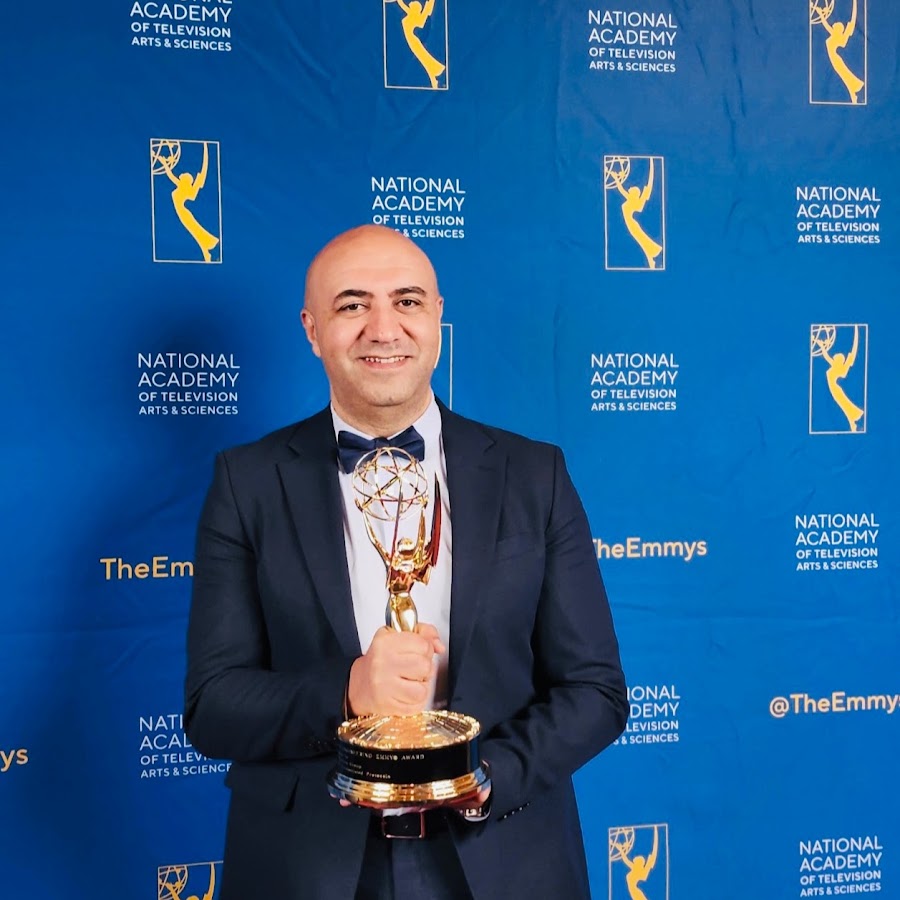
Imed Bouazizi with his Technology & Engineering Emmy statuette.
The technical lineage began with 3GPP Adaptive HTTP Streaming in Release 9. That work was selected as the baseline for MPEG-DASH in 2010, helping create a unified, interoperable streaming standard across mobile and television delivery. DASH lets a player adapt media quality to changing network conditions, reducing stalls while using ordinary HTTP infrastructure and general-purpose content delivery networks.
Read Qualcomm's account of the award.
Recent work: AI traffic on 6G
My current focus is understanding how AI becomes a first-class network workload. I lead the 6G Testbed and AI Traffic Characterization project in the 5G-MAG Reference Tools effort: an open-source framework that measures and analyzes how AI and LLM services behave under realistic network conditions, built to support the 3GPP SA4 6G media study. It pairs a scenario engine (chat, agentic AI over Model Context Protocol tools, image generation, multimodal, video understanding, and real-time WebRTC/WebSocket) with a Linux network emulator and 60+ AI-specific metrics such as time-to-first-token and time-per-output-token. See it under projects.
Standards leadership
I am an active contributor and editor across MPEG, 3GPP, Khronos, and the IETF. Much of this work is paired with open, runnable reference software. I believe a standard is only as good as the implementation that proves it, which is why the projects on this site are working prototypes of the specifications I help write.
Research impact
My academic and industry research spans multimedia streaming, multipath video delivery, forward error correction, and immersive media. It has been cited more than 5,500 times (h-index 33, i10-index 97), across 80+ publications and numerous granted patents. Earlier in my career I also published foundational work in mobile and ad-hoc networking.
Beyond standards
I like to build. Outside of formal standards work I prototype 3D Gaussian-splatting viewers, WebNN and WebCodecs experiments, MPEG-I scene renderers, real-time voice agents, and developer tooling, most of which lives on this site or on GitHub. This site is also where I write about the economics and geopolitics of AI on the blog.
LinkedIn · GitHub · Google Scholar · dblp · ResearchGate